Friday, March 17, 2017

Renting a Traditional Machiya House - in a Hotspring Town!


This may just be the ideal Japanese hotspring stay for adventurous travelers, in terms of international bragging rights, quality of its mineral-laden water, and its inexplicable anonymity even among the Japanese themselves.


Despite its distinction as the only Japanese hotspring town enlisted as a UNESCO World Heritage Site, Yunotsu is so off-the-beaten-track that most Tokyoites won't be able to point to it on a national map. To be fair Japan is blessed with numerous World Heritage Sites -- not to mention hundreds of hotspring towns with inferior water -- that enjoy far greater popularity with domestic tourists. So why haven't people heard of Yunotsu?


For starters we're on the isolated San'in Coast, hours away from the Shinkansen route and 8 hours from Tokyo even on the fastest trains. While Yunotsu remains severely underrated today, it was virtually unknown before the tiny hamlet was elevated to World Heritage status as an extension of the historic mines that produced a third of the world's silver back in the 17th Century.


Yunotsu was the ideal homebase for our visit to the silver mines of Iwami Ginzan, offering the convenience of a train station for our late arrival from Izumo and eventual departure to Tsuwano, not to mention the irresistible allure of a 1300-year-old hotspring on the rugged Japanese coastline. And once we stumbled upon the opportunity to rent our own traditional Machiya house in the hotspring town, it absolutely became one of the highlights of our 16-day trip.


Renting a Machiya, the classic wooden Japanese house centred around a living space of Tatami flooring, is one of those quintessential experiences that always make the best memories on our Japan trips. In Kyoto we rented an ageless Machiya near Nijo Castle, and in Kurashiki we rented a contemporary one overlooking the old feudal town, both times at prices comparable to (and even cheaper than some) bland Westernized hotels. This elegant 2-storey rowhouse, one of several available for rent at this charming hotspring town (see our complete list at the end of this post), would become our homebase for the next two nights.


Compared with our cozy rental Machiya at Kurashiki, our house in Yunotsu was much more spacious with one 6-Tatami living/sleeping space, a kitchen/dining area of similar size, laundry, bath and toilet on the main floor, plus another 6-Tatami bedroom upstairs to sleep up to six people in total. At the time of writing nightly rates start from 5400 yen (CAD$64) per person for double occupancy, similar to your standard midrange business hotel in major cities.


This rental Machiya was operated by Kiunsoh, Yunotsu's premier Ryokan where the cheapest half-board stay (including an extravagant dinner and breakfast as usual) started from 12600 yen (CAD$148) per person. Our entire house for 5400 yen per person was quite a bargain in comparison, and we did make use of this highly functional kitchen with an induction stove top and hood fan, gas broiler, full-sized fridge, toaster over and of course the Japanese essential of rice cooker.
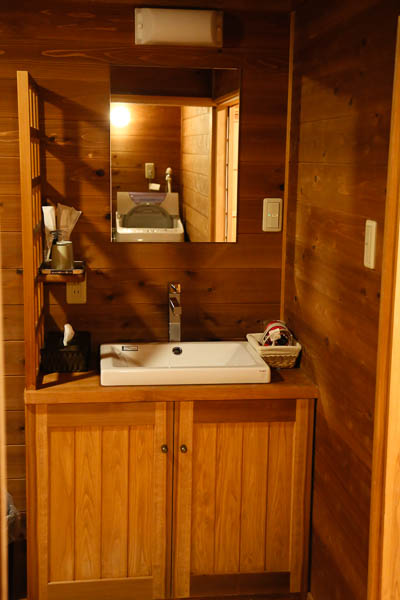


One remarkable difference between Japanese and Western house layouts is that the bathroom, toilet and washbasin may be in separate rooms of the house. Our Machiya was fitted with a new Western-style toilet with a small washbasin on top of the water tank, a cool Japanese invention for water conservation where the incoming water is used for hand washing before it goes to flushing. The main washbasin for personal grooming may then be placed elsewhere -- outside of the toilet room and the bathroom in this case.


The best thing about renting a Machiya from Kiunsoh was the entitlement to enjoy the Ryokan's classy hotspring pool, in fact the only open-air hotspring pool in town, along with all the other guests paying 12600 to 18900 yen per night! And if you're too shy to strip naked in front of strangers (of the same sex of course), Kiunsoh had another small hotspring pool available for private use by couples or family members. This made the pictured bathtub inside our Machiya somewhat redundant, though we're really impressed by its state-of-the-art computerized control for water temperature. This was definitely our poshest Machiya stay so far.


It gets even better with the Japanese combo of integrated washer/dryer, always an oasis for independent travelers like ourselves on extended trips across a country where coin laundry shops are few and very expensive (try 1300 yen for wash and dry). Needless to say modern essentials such as air-conditioning, local TV channels and WiFi were also provided.


Aside from the pictured hotspring bath at Kiunsoh, the town of Yunotsu boasts two public bathhouses including the 1300-year-old spring of Motoyu. One morning I walked to the bathhouse carrying nothing but a Tenugui towel and the entrance fee of 370 yen, stripped off my Yukata into the wooden locker and entered a blindingly steamy room where the opaque springwater gushed out at a scalding 49.7 degrees Celsius. To be honest I had to stand up from the pool and cool down every two minutes, but it was my most satisfying soak in years.


After the morning soak it was time for breakfast at the Ryokan, a definite bargain for 1080 yen (CAD$12.7) considering the lavishness of the traditional 8-course meal. How lavish are we talking about? Well ...


How about some locally harvested Squid Sashimi with Ikura, or pickled salmon roes, so fresh and sweet that it came with no hint of fishiness whatsoever. And remember, we're not even at lunch yet.


This had to be the most perfect Onsen Tamago, or Japanese hotspring egg, I've had since our stay at Ryokan Aiso in Uji years ago. You simply can't get a more perfect yolk -- semi-solid and yet still melt-in-your-mouth -- with a velvety egg white that remained more liquid than the yolk. This was of course the Japanese magic of poaching eggs at very low temperatures, which is more difficult than it sounds according to my own experimentation at home. With deep Umami flavors from a top quality Dashi broth, I'd be willing to spend half of the price of our breakfast for this one egg.


The hot entree of the morning was a Nabemono of Tofu and Shimeji mushrooms in a savory Kombu broth, and on the next morning it was the Japanese adaptation of bacon and eggs, amusingly sizzling on a traditional Donabe clay dish. Steamed rice was all-you-can-eat, accompanied by the local specialty of Miso Soup with Shijimi clams, omnipresent wherever we traveled in Shimane Prefecture.


Of course it wouldn't be a complete Japanese breakfast without a grilled fish, an Aji (horse mackerel) on this morning and a small sole the next day. But the distinction of the best dish really belonged to its sidekick in the tiny pink bowl, highly recommended by Kiunsoh as a house specialty.


The little dish of Uni Shiitake, soy-stewed Japanese mushrooms in a spiced concoction of sea urchin roes, was seriously the best Chinmi (Japanese pickled delicacy) ever, imbued with essences of Mirin, chili peppers and that unmistakeable richness of quality Uni. Savoring each tiny sliver of Shiitake and downing it with steamed rice was my favorite part of breakfast at Kiunsoh.


Like any good money-making Ryokan, Kiunsoh makes its house specialty available for purchase from its little souvenir shop ... and nowhere else in the world! A neighboring Obaasan was apparently so impressed that she snatched up five packages of Uni Shiitake at 1080 yen each. I ended up buying some toothpick holders, a coaster made of the locally famed volcanic rock from Fukumitsu along with one package of Uni Shiitake, which I'm still enjoying at home whenever I wish to relive our two wonderful days in Yunotsu.


As for our own kitchen, it became our lifesaver one night when the only restaurant in town (Cafe Roan) was fully packed with visitor arriving for the weekend Kagura Dance performance. We filled up on three different flavors of instant Ramen and a variety of Age-Kamaboko fish cakes, bought for about 1000 yen at one of the town's two supermarkets.


Having spent most of our time in picturesque Omori and at our favorite eatery in nearby Nima, we hardly left any time to tour Yunotsu itself, a nationally protected town for Important Traditional Architecture. Even with 6 nights in Shimane Prefecture we felt like we're only scratching the surface of this exotic and ancient region of Japan.


PRACTICAL INFO

The hotspring town of Yunotsu is located on JR's Sanin Mainline, 1.5 hour west of Matsue, 4 hours from the nearest Shinkansen stops of Okayama or 5.5 hours from Osaka.

For fellow travelers wishing to rent a traditional Machiya house, here is a list of available houses as of 2017.

Kiunsoh
As mentioned above, Kiunsoh is a respectable Ryokan inn that also happens to rent out vacant Machiya houses in town. They have a total of 4 townhouses, starting from 5400 yen per person per night based on double occupancy, as of 2017.


Meguruya
One of Yunotsu's trendy cafe/zakka shops, Meguruya rents out the second floor of its shop for families or group of close friends to crash for a night, for 4000 yen per person. Bathing at the public bathhouse would be a must since the house comes with no shower/bathtub.


Yakushi-yu
The venerable Yakushi-yu, the larger of Yunotsu's two public bathhouses, has an entire house for rent for 8500 yen per person per night. We're talking a sizeable 20-Tatami house, including free bathing at Yakushi-yu of course.

Friday, March 10, 2017

Sashimi That Still Moves! Our Favorite Dinner in West Japan


This meal was one of our best memories of West Japan, starting with the initial reservation phone call -- in my broken Japanese -- prior to flying to Hiroshima. Impossibly fresh seafood, extremely friendly chef, ridiculously cheap prices, AND easily accessible by train if you're visiting the UNESCO World Heritage Site of Iwami Ginzan. How good is this?


Food Review: KAMEYA (Nima)
Address: Nima-cho 1415-5, Oda-shi, Shimane Prefecture
Hours: Open for Lunch and Dinner on most days, but best to call ahead at 0854-88-3075
Map: from Google Maps
Directions: Starting from Nima Station, walk north along the road parallel to the train tracks for 500m, then turn right at the main crossroad (Route 235). Kameya is on the right side before the train tracks.


By pure chance we stumbled upon our favorite little eatery in West Japan while researching for dinner options for our 2-night stay at the hotspring town of Yunotsu, one of Japan's least visited World Heritage Sites. As restaurants were nearly non-existent along this sparsely populated stretch of the San'in Coast, I took the leap of faith to call Kameya and book ahead, based solely on unconfirmed reports from a local website.


My conversational Japanese was -- and still is -- a terrible mishmash of short sentences assisted by Japanized English terms, barely enough to communicate our arrival time and choice of Teishoku meal over the phone. Two weeks later we showed up at Chef Ido's one-man operation, luggage in tow and trapped for hours between infrequent trains, to find our Taisho cordially awaiting our arrival, so well-prepared that he had even arranged a special translator for us in the form of a teenage niece.


The Teishoku meal that we pre-ordered was the Ikizukuri, or Live Sashimi ... which meant exactly how it sounded. Within minutes Chef Ido took from his fishtank an beautiful mid-sized fish, pretty enough to be an aquarium exhibit with sparkling scales and dazzling zebra stripes. Somewhere between the cleaning of the fish and the appearance of the appetizer, the chef's niece arrived from her nearby house. (Hello Minori-san!)


Still in her early teens, Minori had to be the most fearless Japanese junior high student I've ever met, in terms of her confidence in speaking with random foreigners in English. This was exactly why Chef Ido brought her along as translator for two clueless Canadians ... and a rare chance to further sharpen her English in a region of Japan that few foreigners visit.

While we're chatting with Minori, Chef Ido went to work and soon produced this fascinating appetizer of regional specialties: Baigai whelk from the rocky coastline, Hotaru-ika (florescent squids) from the fishing boats, and the simmered, velvety rich liver from a mysterious fish to be featured next on our Sashimi plate.


This was by far the most impressive dish of our 16-day trip, an extravagant arrangement of two large conches and four local fish at their absolute peak of freshness, shared between just the two of us.

And the kicker is ... this was just one of many dishes in an impossibly cheap meal of 2500 yen (CAD$29.4) per person.

To give an idea of how gigantic this Sashimi plate was, each conch at the centre was about the size of my palm, and the dish itself was close to a half metre in diameter. This level of lavishness was certainly beyond what we'd usually spend on dinners, especially in large cities where a Sashimi-mori of this colossal size and uncompromised quality would have cost a fortune -- and that's before considering that one of our fish had to be served alive as Ikizukuri.


Featured prominently was the zebra-striped fish that our Taisho took out of the water merely 20 minutes ago, known as Ishidai according to Chef Ido and apparently prized among anglers for its mildly sweet flesh and a chewy texture reminiscent of Japanese seabream. My wife and I were just blissfully chatting with Minori and savoring our Sashimi until I noticed ...


.. the fish's gill cover kept opening and closing in front of our eyes!

What exactly it was breathing I had no idea, as half of its body was neatly plated on the Shiso leaves and the other half was already in our stomachs. My wife wished in retrospect that I hadn't told her, though this had to be unquestionably the freshest Sashimi we've ever had. Period.


This definitely wasn't your standard assortment of Akami tuna, Buri or Katsuo served in most Izakayas in Tokyo or Osaka, but three exotic species of local catches that we had never seen, let alone tasted, anywhere else. These two Yumekasago, or Japanese scorpionfish, were entirely different from the Ishidai with a softer texture yet the same level of absolute freshness ... and without thrashing around on our plate.


Even sweeter in flavor was this odd-looking fish with an angular head, bright orange body and disproportionately large pectoral fins that resembled the wings of a small airplane. According to Chef Ido, this was a locally prized fish in the autumn and winter season with the affable name of Houbou, coined for the loud vibrating sound it made with its swim bladder. As you can see we learned much about Japanese seafood on this evening from our master chef.


Starting with the fascinating array of fishes and gradually working our way towards the succulent Tsubugai conches at the centre of the ginormous platter, we took more than an hour to finish this one epic dish that would probably cost 8000+ yen (CAD$94) in Tokyo, except that we're paying a fraction of the price at this remote fishing port in West Japan.


And that was just the start. Arriving next were four grilled fish in Shioyaki style, two being some sort of rockfish and two being the local autumn specialty of Hatahata (sandfish), all seasoned in nothing but sea salt and expertly broiled to perfection. This was really over the top, in terms of both quantity and quality.

Minori had been translating for us this whole time, bridging our conversation with Chef Ido who shared his joy of living on the San'in Coast, the low cost of living in rural Japan, his cute grandkids in Shanghai, and of course his passions about food. Everyone was having a good time, though I suspected that we were keeping Minori from finishing her daily homework.


While Chef Ido served up these silky smooth bowls of Chawanmushi custard, we chatted more with Minori about the Japanese school year, her experience on a short-term exchange to Australia, and her aspirations to attend university in West Japan and become a professional translator. There is no doubt in our minds that, with some hard work in her upcoming pivotal years of senior high, this intelligent young lady would one day reach that goal.


And while we're having this great conversation with Minori, Chef Ido kept serving up more delicacies such as this family-style Tempura of Squid Tentacles. The amount of food served, at the rock bottom prices that Chef Ido charged, was simply becoming ridiculous.


And don't forget the salad, homemade Tsukemono, and a seriously good Aka-miso soup flavored with a whole fish head. We're talking an 8 course dinner with 8 fish (4 as Sashimi, 4 as Shioyaki) shared between the two of us, plus the conches, squids, Chawan-mushi and Tempura, for an impossible price of 2500 yen (CAD$29.4) per person. I would have gladly paid 6000 yen per head in Tokyo ... and that's without Minori-san's personal translation service!


Two-and-a-half hours were too short for an exceptional dinner with some great memories, of our marvellous Taisho Ido-san and of course Minori-san, who will become a professional translator someday I'm sure. 夢を目指して頑張ってくださいね、みのりさん!


That evening we caught the tiny conductor-less train to the hotspring town of Yunotsu, where we rented a traditional wooden Machiya for two nights as homebase for our day-trip to the UNESCO World Heritage Site of Iwami Ginzan. For the rest of our journey we never encountered Sashimi of this incredible freshness again, and that's a testimony to the skills of Chef Ido and his little shop on the isolated San'in Coast.

Bill for Two Persons
Ikizukuri Teishoku x 2 5000 yen
Bottle of Draft Beer600 yen
TOTAL5600 yen (CAD$66)

Friday, March 3, 2017

Izumo beyond its Uber-Famous Shrine


As strange as this may sound, our favorite attraction in Izumo was not the Izumo Taisha, but a majestic and yet defunct train station stuck in the past century.


Like any first-time visitor to the San'in Coast we paid our obligatory visit to the grandmother of all Shinto Shrines, one of the known birthplaces of the Japanese civilization and a designated National Treasure. We're tiptoeing on ground-zero of Japanese creation myths in the ancient land of Izumo, held in distinct reverence in the Japanese psyche for the past millennium.


This was the third day-trip destination from our homebase of Matsue, the first two being the historic town of Kurayoshi and the world famous Japanese garden at Adachi Museum. We checked out of our rented apartment in the morning, took the JR train to Izumo-shi, stashed our bulky luggage (which didn't fit into the standard coin locker) at Ichibata Railway's ticketing office, and hopped on an Ichibata bus which delivered us straight to the closest entrance (i.e. side entrance) to Izumo Taisha.


Despite having visited another one of Japan's so-called Three Great Shrines, I was still taken aback by the palace-like compound with bureaucrats (i.e. Kannushi) dressed in white uniforms, application offices for wedding ceremonies and group visits, and walls to protect the Main Hall from being desecrated by curious tourists. Peek-a-boos over the wooden barriers offered the only glimpse at a brand new thatched roof, last replaced in 2013 as part of the shrine's major renovations every 60 years.


Perhaps it was the inevitable side effect of history and fame, but the Grand Shrine simply felt way too grandiose for our preference, constantly surrounded by megaphone-touting tour operators setting up that mandatory group photo with its iconically ginormous straw rope, thickest in the world and heavier than most pickup trucks. After barely 80 minutes we left Izumo Taisha searching for another centuries-old local tradition that would prove more fulfilling for us.


Food Review: YAKUMO HONTEN (Izumo-shi)
Address: Taishacho Kizukihigashi 276-1, Izumo-shi, Shimane Prefecture
Hours: 09:00-16:00, Closed on Thursdays
Map: from Google Maps
Directions: From the main shrine, exit through the western entrance instead of the main (southern) entrance. Keep following the side street for about 200m towards the main road. Yakumo is on the right hand corner of the main road.


While Izumo is revered by Shintoists as the meeting place of spirits, it is likewise revered by foodies as one of the meccas for Soba, the original Japanese noodles and soul food before the 20th Century importation of Ramen. One of the Soba specialists in town claiming to have served the Japanese royalty was Yakumo Honten, whose head chef had apprenticed at Shiga's 300-year-old Tsuruki Soba, official supplier to the Emperor.


What put Izumo on the map for Soba enthusiasts is the regional specialty of Warigo Soba, a colorful variant of chilled Soba in which the noodles are served in a series of lacquered bowls stacked on top of one another, with the Tsuyu sauce directly poured into the first bowl and the leftover transferred to subsequent bowls.


The two of us shared a stack of five Warigo with a deliberate sequence of toppings: light-tasting grated yam in the first bowl, a raw egg in the second, crunchy Tempura bits in the third, flavorsome Katsuobushi in the fourth, and palate-cleansing grated Daikon in the final bowl, all served with seaweed, spicy Momiji-oroshi and green scallions.


Chilled Soba always calls for the essential pairing of a good Tempura Mori, served here at the slightly inflated price of 1200 yen. While premium ingredients such as prawns and a Kisu fillet were included to justify the price, my personal favorites were leafy vegetables such as Shiso and Yakinori, along with the Shishito pepper.


Aside from Warigo Soba we sampled another local specialty of Agonoyaki, a tube-shaped Kamaboko made out of flying fish from local fishing ports, with a much chewier texture compared with your typical supermarket Chikuwa.


I could not resist one final bowl of local Shijimi clam soup prior to leaving Lake Shinji behind. That afternoon we would depart from the flatlands of Izumo and venture into neighboring Iwami, better known for rockfishes reeled in from its craggy coastline.

Bill for Two Persons
5-Shiki Warigo Soba1640 yen
Tempura Mori1200 yen
Agonoyaki650 yen
Miso Soup with Shijimi Clams250 yen
TOTAL3740 yen (CAD$44)


Whereas Izumo Taisha was the main attraction for domestic Japanese tourists, even more fascinating for me was the Museum of Ancient Izumo, one of very rare museums in Japan tackling the touchy subject of the origins of Japanese civilization ... particularly its intimate ties with the advanced cultures of Continental Asia 2000 years ago. Greeting visitors at the foyer were three unearthed gigantic cedar stumps which formed ...


... one of the main pillars from a 12th century incarnation of Izumo Taisha, 48m in height and certainly one of the most impressive wooden structures of the medieval world. Shanxi's 1000-year-old Yingxian Pagoda might have been taller (67m) in comparison, but this would have looked magical with a whole shrine perched on top of 12-storeys tall cedars.


Even more impressive was the entire wall of bronze swords unearthed in Izumo, testimonies to the most advanced civilization in 3rd century Japan before the rise of centralized power at the Yamato courts in modern day Kansai. For those who have visited bronze age sites on the Asian mainland such as the Terracotta Warriors in Xi'an, the collection of bronze ceremonial bells here, merely 300km off the Korean shoreline, should look very familiar.


And this inevitably leads to questions about the birth of Japanese culture and Korean influences, highly delicate subjects amidst decades of animosity between Japanese and Korean governments. That said, local folks in Shimane seem much more accepting compared with Tokyoites of cultural exchanges with their western neighbour, one man even boasting to me about visiting Seoul more than 30 times due to the convenience of short flights from Izumo Airport. Apparently Izumo still remains Japan's gateway to Continental Asia, 1800 years after the bronze bells.


The shrine was nice, the museum was better, but our day-trip would have been slightly underwhelming without this one final sight, much more hands-on and therefore more enjoyable to us than the Grand Shrine itself. Within a seemingly unremarkable residential area south of the shrine stands possibly the most beautiful train station anywhere in Japan ... except that the last train had departed a quarter century ago.


Architecturally exquisite enough for a classy Ryokan or a hotspring bathhouse, the defunct Taisha Station once served as the important terminus for trains from all corners of Japan transporting Shinto pilgrims to the Grand Shrine. In its heyday chartered trains for schools and private companies would call alongside express sleepers sprinting directly from Tokyo, all converging at this stunning building now designated as national heritage.


Archaic hand-operated ticket machines, VIP waiting rooms in elegant dark wood, meticulous details such as logos of train wheels on traditional Onigawara roof tiles -- unsuspecting visitors are transported back to the good old days of Emperor Taisho, before the Great Depression and subsequent years of war and suffering.


Posted next to the tourist info booth and ticket windows was a hand-scribbled table for ticket prices left behind when the station was decommissioned in 1990, when a slow train to Tokyo would set you back 11200 yen, surprisingly current compared with 11900 yen in 2017. That's a powerful illustration for anyone wishing to understand the reality of Japanese economic stagnation over a quarter century.


According to the final timetable, Taisha Station was respectably busy even at the time of decommissioning with 15 trains a day connecting to Izumo-shi and beyond. All that remains now is one pre-WWII D51 steam locomotive left to decay at Platform 2, to be explored at the visitor's own risk.


Pilgrims back in the day would be greeted by a listing of every major Ryokan with their prehistoric 5-digit phone numbers, surely a lifesaver for first timers unaware that the Grand Shrine was a 25 minute walk away. Today's visitors would arrive much closer at Izumo Taisha-mae Station of the quaint little Ichibata Railway, which has so far staved off extinction as a community-owned railroad.


We came across only 6 visitors -- all Japanese -- in 45 minutes at the old Taisha Station. By 15:10 we were on a bus back to Izumo-shi to pick up our luggage and take the next local train down the San'in Coast. We would spend the next two nights at the UNESCO World Heritage hotspring town of Yunotsu, but not before stopping for what turned out to be our best meal in West Japan.